

 by
by 
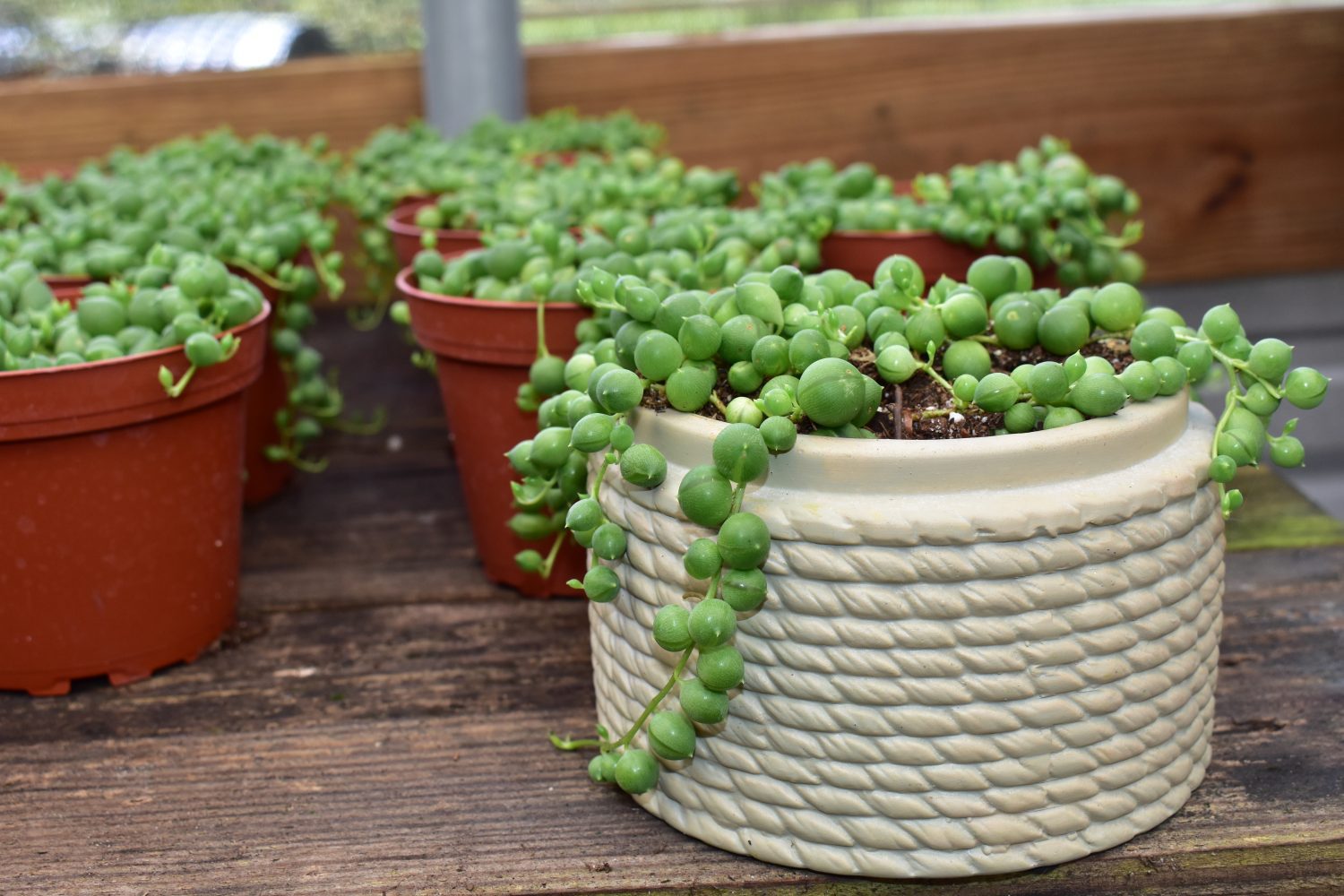
The String of Pearls (Senecio rowleyanus) plant is an odd-looking plant. It is named after Gordon Douglas Rowley. He was a British botanist known for his work on succulent plants.
The String Of Pearls plant. It is also called the rosary string of beads or the string of pearls plant. This creeping succulent is native to the drier parts of southwest Africa.
In its natural environment, its stems trail on the ground, rooting where they touch and forming dense mats.
The odd shape of the leaves is an adaptation to arid environments. It allows for the storage of water. This shape exposes the least amount of surface area per volume to the desert air.

This greatly reduces water loss due to evaporation compared to the typical dorsiventrally flattened leaves of most angiosperms.
Although its spherical leaf morphology contributes to minimizing water loss. While also dramatically reducing the area available for the absorption of light. This is detrimental to the plant’s rate of photosynthetic carbon assimilation.
An adaptation that helps compensate for this reduction in light interception is a narrow, translucent band of tissue. This crescent-shaped band is located on the adaxial side of the lamina. Lamina is a thin layer, plate, or scale of sedimentary rock. It can also be organic tissue or other material. In this case, it is the leaf of the plant.)

This specialized structure is known as an “epidermal window.” It allows light to enter and irradiate the interior of the leaf. This effectively increases the area of leaf tissue available for photosynthesis.
This is a trait shared with Senecio radicans, a close relative of Senecio rowleyanus.

Species of the genus Fenestraria exhibit a similar morphology. The species Haworthia cooperi and Frithia pulchra also share this trait. They grow underground and only expose their leaf tips to absorb light radiation.
It often avoids direct sunlight by growing in the shade of other plants and rocks.
This interesting houseplant not only has a carefree growth habit but also offers a unique focal point. It can spark conversation in the home.
The String of Pearls’ houseplant makes an excellent conversation piece. Your family, friends, and neighbors will love it as much as you will.
The String of Pearls plant sprawls over the edges of containers or hanging baskets. It resembles a beaded necklace with its fleshy green, pea-like foliage.
The flowers seem small and unattractive to some people. This is if they’re even lucky enough to get them. However, others find the faint white blooms, which smell a bit like cinnamon, quite pleasing.
Still, it’s the thin, thread-like stems. The flesh,y round, bead-like leaves make this unusual houseplant a great addition to the home.
String of Pearls Care
As with most succulent plants, the String of Pearls requires little care. There’s little maintenance involved with growing a rosary string of beads plant. But, you will need to give it with some care.
This succulent plant is drought-tolerant, surviving long periods without water.
The plant’s water-storing abilities are impressive. You can water it thoroughly once a week. Then it can be pretty much forgotten the next week or two.
Watering too often can increase the chances of root rot. So be sure to let the soil dry out at least half an inch or so between watering.
Light
The String of Pearls plant should be placed in a place that receives bright light. The pot can be placed on a window that faces south or west.
The plant will thrive with 2-3 hours of direct sunlight. It also needs bright, indirect light for the rest of the day. If you are unable to find such a place, you can place them under a fluorescent light fixture.
During the growing season, around 14 to 16 hours of artificial light on a daily basis will suffice.
Soil Requirements
Good drainage is extremely important, which is why the use of sandy soil is suggested. You could also use a potting mix that is meant for succulent plants.
You could also mix potting soil and sand in the ratio of 3:1. Make sure that the soil is well-drained.
Allow the soil to become slightly dry before you water the plant.
Watering
Being a succulent plant, String of Pearls can retain moisture in its foliage. The plant is drought-tolerant, which is why occasional watering will suffice. You can water the plant thoroughly once or twice a month.
Reduce the frequency during the winter. Water in such a way that the soil just remains damp or moist. Make sure that the pot has drainage holes.
If the pot is placed on a drainage saucer, make sure that there isn’t any water remaining in the saucer. If the plant is watered frequently, the soil will become waterlogged, which will make the plant susceptible to root rot.
Temperature
Place String of Pearls plants in average room temperatures. If the plant is placed indoors, make sure that the room temperature ranges between 55°F and 80°F. Ideally, the temperature range should be 70-80°F from spring through fall, and 55-60°F in winter.
Though this plant is heat and drought-tolerant, it is not cold-tolerant.
Make sure that the temperature is never less than 45 degrees. So, don’t place it at a place where it is exposed to cold air. Cold air could make the plant susceptible to leaf drop.
Fertilizer
Apply a general-purpose liquid houseplant fertilizer once or twice a month during spring and summer. Make sure that you dilute it to half of the solution recommended on the label. There’s no need to apply the fertilizer during the fall and winter months.
Propagation
Stem tip cuttings can be used for the purpose of propagation. All you need to do is cut a healthy stem tip. The cutting should be at least 4 inches long.
Place it in a moist potting mix. Make sure that the leaf nodes are covered with soil.
The roots will quickly develop from the axils. This term refers to the place where the leaves are attached to the stem.
Repotting
Repot the plant when it becomes root-bound. You can mix commercial potting soil and sharp sand in a 3:1 ratio. Alternatively, use a potting mix meant for cacti or succulent plants.
In winter, cut back watering to about once a month. Occasionally, you need to prune your String of Pearls. This is necessary to maintain its size or appearance.
This is simple to do. Trim off any dead stems and pearls, as well as any stems that have lost a lot of their ‘beads.’ Pruning back will help promote fuller, more compact plants.
Even better than its ease of care is the fact that you can share the plant with others. Whenever pruning is in order, you can take advantage of the plant’s easy propagation. Simply place a cutting or two in a pot of soil, and they will easily take root.
How Poisonous Are String of Pearls Plants?

The String Of Pearls plant (Senecio rowleyanus) is a succulent. It has small, spherical leaves that look like a string of pearls.
It is also known as a string of beads. This attractive succulent is interesting to look at. For some animals and small children, it also looks good enough to eat.
The String of Pearls is on the toxic plants’ lists for humans and many pets. You will want to consider this fact before purchasing this charming plant.
String Of Pearls Toxicity
It is rated as toxicity classes 2 and 4 by the University of California, Davis. Class 2 means minor toxicity; ingestion of a string of pearls can cause minor illness, like vomiting or diarrhea.
Class 4 means dermatitis; contact with the plant’s juice or sap can cause skin irritation or rash. If your child ingests a string of pearls, call the Poison Control Center or your child’s pediatrician immediately.
In pets, including cats and dogs, possible symptoms of ingestion of the string of pearls plant include drooling. They can also show symptoms like diarrhea. They also experience vomiting or lethargy. Some suffer irritation to the skin or mouth due to contact. Contact your veterinarian immediately if you believe your pet has ingested this plant.
Two Unique Alternatives
If you don’t want to risk your child’s or pet’s safety, there are non-toxic succulents available. The burro’s tail succulent (Sedum morganianum) has silvery, bluish-green, plump, oblong leaves that hang along a thick stem.
This easy-to-grow, low-watering plant spills out of its container or works as a ground cover. It likes direct sun indoors and full sun to partial shade outdoors. It prefers temperatures over 45 degrees Fahrenheit and does best when outdoors in USDA zones 10 through 12.
The snake plant (Sansevieria trifasciata) is also known as mother-in-law’s tongue.
It has sword-like green to gray-green leaves. The leaves show variations of mottled, striped, or blotched variegation. These variegations come in shades of green, yellow, or white.
This subtropical to tropical member of the succulent family requires bright light and minimal watering. It is often grown as a houseplant but can live well outdoors in USDA zones 9b through 11.
Keeping Children And Pets Safe From Toxic Houseplants
Taking advice from the ASPCA on cat-proofing your house can help protect other pets and your children from toxic plants.
Pets and small children cannot discern between toxic and non-toxic plants. Take precautions to keep them safe. This way, you may avoid having to throw favorites like a string of pearls out of your home.
Place houseplants on top of high windowsills and tall, inaccessible furniture such as an armoire. Hang cascading plants high from the ceiling and trim them before they grow low enough to reach.
Like what you read? Appreciate the information. We are a non-profit 501c3! Thank us with a contribution by clicking DONATE!


 by by
by by
Leave a Reply