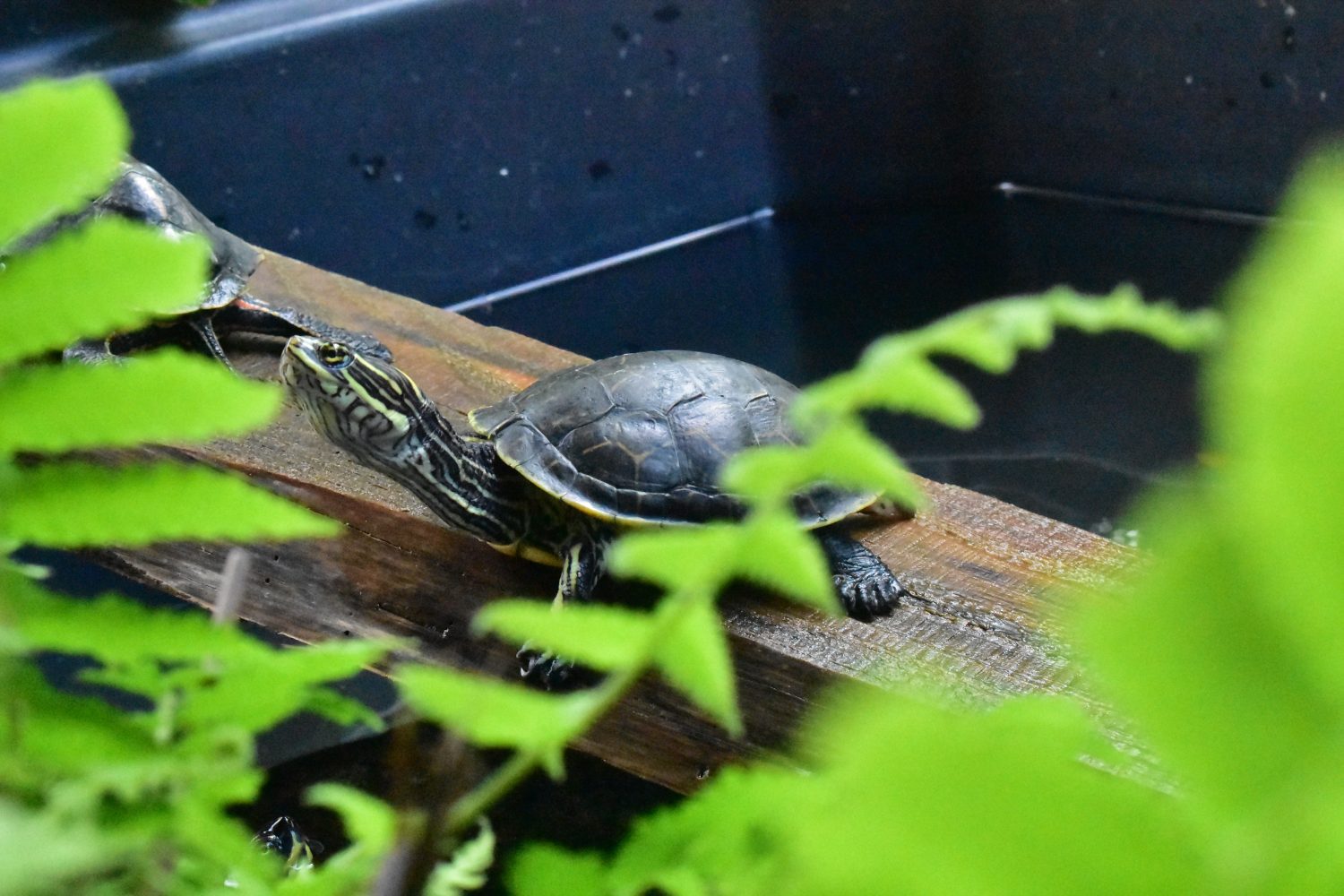
The Chicken Turtle (Deirochelys reticularia) is a semi-aquatic turtle. It is similar in appearance to the eastern painted turtle (Chrysemys picta picta). However, it has an unusually long neck.
First described as Testudo reticularia by Latreille in 1801.
Animals are often reclassified. Science now has more access to sophisticated testing methods. DNA advancements allow researchers to place proper families together.
This reptile is found in the Coastal Plain of the southeastern U.S. but is absent from the Piedmont and Mountains.
This species is found in a variety of heavily vegetated aquatic habitats.
Nonetheless, it is generally absent from large permanent ponds and reservoirs. Chicken Turtles are most common in shallow, still waters, particularly ephemeral and seasonal wetlands with abundant vegetation. Chicken turtles are basking turtles, sometimes seen on logs and stumps.
This species has a much “faster” life-history than other American aquatic freshwater turtles. This means that young people grow and mature quickly. Additionally, adults do not live as long as other species. Wild chicken turtles have been recaptured up to 15 years after their first capture. Some reached the known highest ages of 20 to 24 years.
- There are three distinct subspecies of Chicken turtle:
- Eastern chicken turtle (Deirochelys reticularia reticularia)
- Florida chicken turtle (Deirochelys reticularia chrysea)
- Western chicken turtle (Deirochelys reticularia miaria)
- Florida Chicken has broad orange or yellow lines on the carapace. There is a wide color band on the carapace rim. There are no markings on the plastron.
- Eastern Chicken Turtles are duller in color compared to Florida chickens. They have narrow green or brown lines on the carapace. There is a narrower color band on the carapace rim. Additionally, there are black markings on the underside of the lateral and rear marginals.
- Western Chicken displays a flatter carapace, broad but faint lines on the carapace, and has dark markings along the plastron seams
Deirochelys reticularia (Family Emydidae)
The Chicken Turtle Is Beautiful
Chicken Turtles are mid-sized turtles with shells that are egg-shaped. These reptiles can get 6-9 inches long. Scute pattern on the carapace is 12/12 marginals, 4/4 vertebral, and 5 vertebrae.
The plastron is hingeless and is 88-91 % of the carapace length. It is yellow and has a faded dark blotch on the posterior half.
The skin is black with distinctive, thin yellow stripes on the back legs and neck. The front of each foreleg has a broad yellow stripe. Furthermore, the neck, when extended, is as long as the carapace.
Our knowledge about the ecology of Chicken Turtles largely stems from population studies. These studies are conducted at the Savannah River Ecology Lab. This is especially true for the work done by Dr. Kurt Buhlmann.
Reproduction
This species of turtle must be 2-5 years old before they reach sexual maturity. Chicken Turtles are unusual among turtles. They have a winter egg-laying period that begins in late summer and early fall.
This odd evolutionary trait declines during the coldest months and resumes again in February and March. Eggs overwinter in the nest and emerge a year or more after eggs were laid.
Since mating occurs in shallow waters, this species can nest at any time during the year. As a result, no description of reproductive behavior has been published. Female chicken turtles can keep eggs for up to 6 months when nesting conditions are not right.
Thus, when she does lay, she will lay 2 to 15 eggs. Chicken turtle embryos go through a period of diapause in the late gastrula stage.
They must experience an of cool temperatures before development proceeds. Eggs hatch in 152 days at 84.2°F. Some hatchlings, especially those from fall eggs, overwinter in the nest and emerge next spring.
Behavior
Chicken Turtles are omnivores; these reptiles will eat Insects, rodents, fish, crayfish, tadpoles, and aquatic plants.
As juveniles, they are more carnivorous. This species is given to wandering long distances from the water. It can often be found along roadsides and in flat woods. They are active between March and September.
They hibernate for the rest of the months in animal burrows. Some bury themselves in the mud at the bottom of ponds. This turtle will forage on land or in the water, and feeding usually occurs in the morning or late afternoon.
Also, they are more active on cloudy rather than sunny days. Furthermore, they will escape predation by diving into the mud and swimming through it. In conclusion, the Chicken Turtle is non-territorial and lives well with others.
Threats To To Wild Populations
This species, for many years, was a favorite soup turtle. Although turtle soup isn’t as popular recently, it is still considered a good eating turtle by many in the southeast.
Threats to this species come from the disruption, destruction, or isolation of freshwater wetlands. This includes small or temporary ones. Additionally, the elimination or alteration of surrounding terrestrial habitats poses a risk.
Eastern moles (Scalopus aquaticus) are a significant predator of chicken turtle nests. As well as snapping turtles and birds of prey.
As a result, the elimination or alteration of surrounding terrestrial habitats. Most noteworthy, the species is not now considered globally endangered. While some peripheral populations (e.g., those in Missouri and Virginia) are listed as locally endangered.
Like what you read? Appreciate the information. We are a non-profit 501c3! Thank us with a contribution by clicking DONATE!
Leave a Reply