
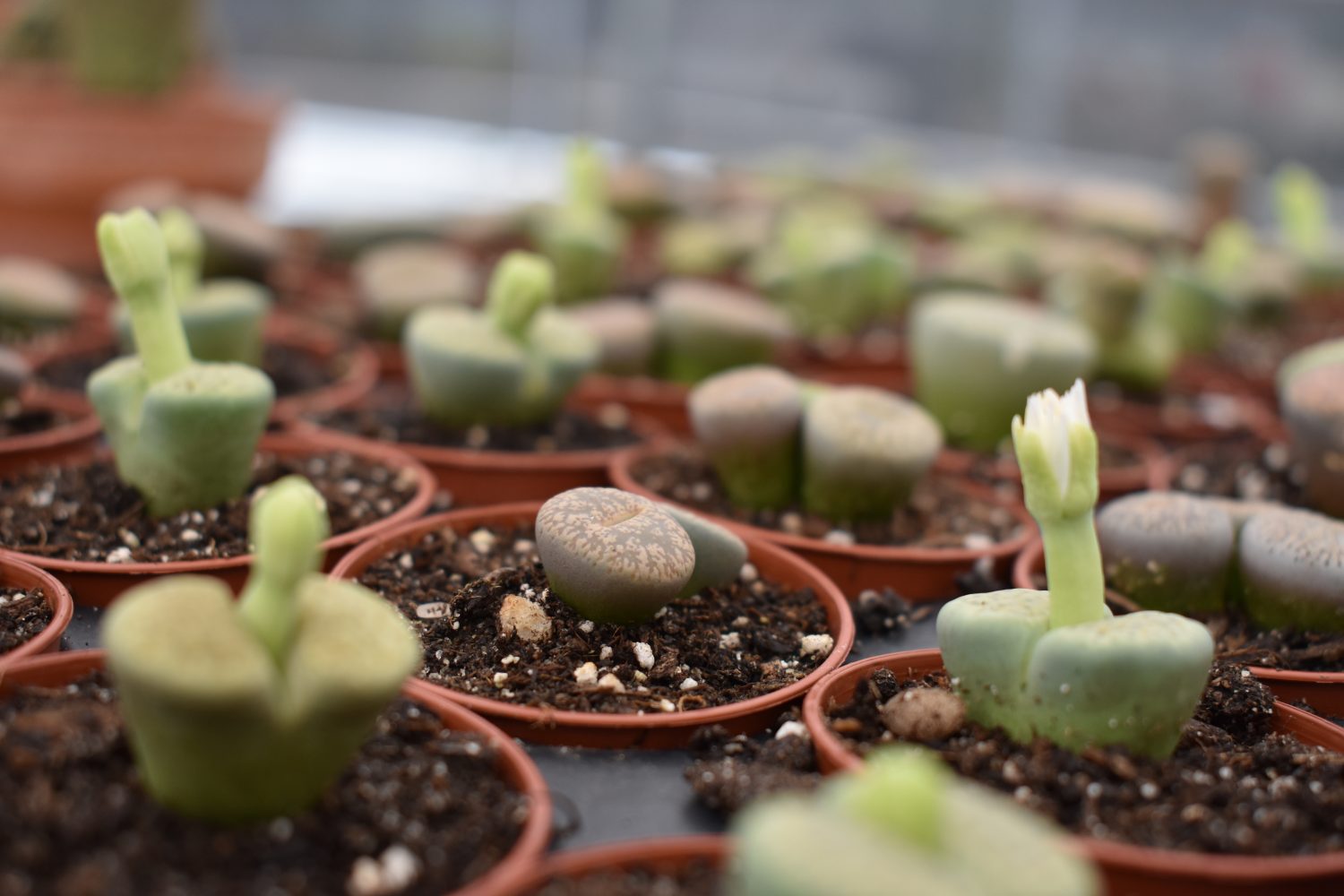
opularly called “Living Stones”, Lithops (pseudotruncatella) are some of the world’s most fascinating plants!
John Burchell discovered Lithops in 1811. He picked up what he thought was a curiously shaped pebble from the stony ground. Since then, collectors of succulent plants have avidly sought Lithops.
They resemble the pebbles and stones among which they grow in their African habitat. They have become favorites of the collector of strange and unusual plants.
Their subtle colors of gray, brown, rust, green, and pink are complemented by their fantastically intricate markings. These features make them most desirable additions to any plant collection.
Lithops is a genus of succulent plants in the ice plant family, Aizoaceae. Members of the genus are native to southern Africa.
The name originates from the Ancient Greek words λίθος (lithos). It means “stone.” Additionally, ὄψ (ops) means “face.” This refers to the stone-like appearance.
Living Stones are known in Afrikaans as beeskloutjies. In Afrikaans, bees means ox or cattle and kloutjie means feet. The plants also look like miniature hoofprints of cattle.
Several areas in which these plants grow receive less than 2 inches of rainfall per month throughout the entire year.
In an extreme situation of low rainfall, at least one species of Lithops relies on mist or fog. This provides its main source of moisture.
Lithops can’t survive in many areas where they are found, were it not for their capacity to store water. Almost the entire plant is devoted to this role.
The “body” of the plant is divided into two succulent leaves fused in the shape of an inverted cone.
The fissure or slit at the top of the plant is the division of the two leaves. There is no stem as such, but rather the taproot joins abruptly at the base of the leaves.
The structure of the plant reveals to the imagination the harsh environment in which Lithops live. Water scarcity requires young plants to limit themselves to only two leaves and a root system. More extravagant growth would only serve to waste water.
The leaves are thick enough to store enough water for the plants to survive for months without rain. The plants are small. They keep a low profile. This helps reduce the effect of the intense heat and light of their climate.
Lithops disguise themselves as rocks for other purposes. Succulents are most attractive to animals because they store lots of water, so they are preyed upon to slake thirst.
While other succulents have sharp armor to protect themselves from browsers, living stones survive through the art of camouflage. Animals can’t easily find these rock-like succulents out of a dry stony riverbed or desert floor.
Lithops are also known as pebble plants, mimicry plants, flowering stones, and, of course, living stones. These are descriptive monikers for a plant that has a unique form and growth habit.
After flowering in the fall, the process extends through winter. During this time, the new ‘bodies’ are forming within the old leaves. The latter become soft and flaccid and begin to shrivel.
Some split into the sides from the pressure of the new body inside. Often, there will be dry or ‘dead’ spots on the old leaves at this stage. This is perfectly normal. Eventually, the old leaves dry up, leaving the plant with a perfect set of new ones.
Lithops are relatively easy to grow. Yet, a little information on them will help you. This knowledge will help you learn how to grow living stone plants so that they thrive in your home.
Lithops should be allowed to go drier in the winter. The new growth is drawing moisture from the old leaves.
At this time, water very lightly, just enough to keep the root hairs alive. Some people suggest an easy way to judge your watering. Imagine you are trying to remove the dust from the leaves.
As the old leaves dry up in the spring, give them more water. Keep doing this until the long, hot summer days bring the growing period to a standstill. At this time, water lightly as stated above, act like you are getting the dust off the leaves.
Lithops do well indoors. They need about 4 or 5 hours of direct sunlight in the early part of the day. Slightly filtered sunlight also works. They need partial shade during the afternoon.
A southern window is usually the best location. Still, avoid it if it exposes the plants to full sunlight most of the day. An unobstructed eastern exposure is a good choice.
If the plant does not get a certain amount of direct sunlight, it begins to grow slender. This happens if sunlight is absent for a few hours a day. They lean to one side to get more light. They also lose coloration, and the sides of the plants turn greenish. They will eventually die if better lighting is not given to them when these signs become obvious.
In some situations, however, it is advisable to shade the plants a little from intense sunlight in the spring. This prevents sunburn. This is especially important in areas that experience poor light during most of the winter.
This is because the plants lose resistance to bright light during a prolonged period of overcast weather. The sudden brightness of a clear day will cause them to become burned. As a result, a whitish scar tissue forms on the surface of the plant.
A badly burned plant is so severely injured that it dies. You should gradually expose the plants to bright light. Do this over several days if they have been in dim light for some time. This is especially true of newly purchased plants.
REMEMBER, you never want the soil to become bone dry. The root hairs will all die back. When you resume watering, there will be no root hairs to begin using the moisture.
As flower buds in late summer and fall, another watering period begins. Tapering off during winter after flowering has ended. Those growing plants under lights need to be watered more during the winter. This happens when the plants show signs of shriveling.
No one can tell you exactly how much water your plants need. You must watch them and learn their growing cycle.
Propagation is through division or seed. Seed-grown plants take many months to settle. They take years before resembling the parent plant. You can find both seeds and starts on the Internet or at succulent nurseries. At the bottom of this page are our suggested Amazon links. We are affiliates and earn a commission on purchases using these links.
Lithops care is easy. You just need to remember the type of climate the plant originates from. Mimic those growing conditions.
Be very careful when growing living stones, not to overwater.
These little succulents do not need to be watered in their dormant season, which is from fall to spring. If you wish to encourage flowering, add a diluted cactus fertilizer in spring when you commence watering again.
Lithops plants do not have many pest problems, but they get scale, moisture gnats, and several fungal diseases. Watch for signs of discoloration and evaluate your plant often for immediate treatment.
Old-hand gardeners know for best success indoor cactus and succulent plants require a certain amount of neglect.
amzn_assoc_placement = “adunit0”;
amzn_assoc_search_bar = “true”;
amzn_assoc_tracking_id = “crazycritte02-20”;
amzn_assoc_search_bar_position = “bottom”;
amzn_assoc_ad_mode = “search”;
amzn_assoc_ad_type = “smart”;
amzn_assoc_marketplace = “amazon”;
amzn_assoc_region = “US”;
amzn_assoc_title = “Shop Related Products”;
amzn_assoc_default_search_phrase = “Lithop”;
amzn_assoc_default_category = “All”;
amzn_assoc_linkid = “ee8dad7859ec0d1b5d122079389a4522”;
Like what you read? Appreciate the information. We are a non-profit 501c3! Thank us with a contribution by clicking DONATE!
Leave a Reply