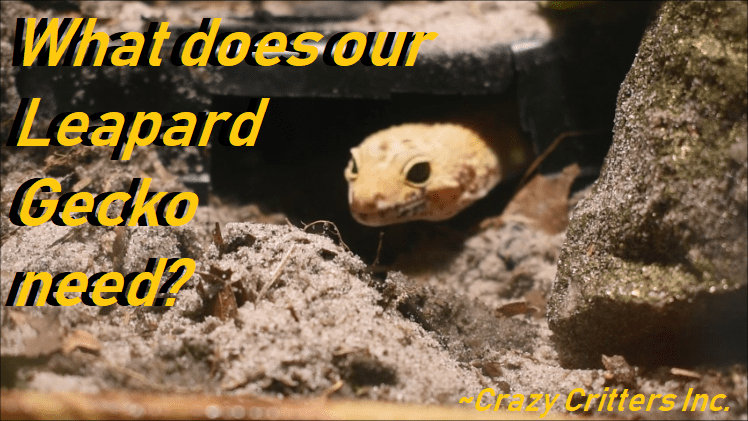
Leopard Geckos (Eublepharis macularius) are lizards that are native to Asia. They live in rocky deserts and sparse grasslands. These reptiles are nocturnal in the wild, hiding from fierce daytime heat in burrows and under rocks.
A popular beginner’s reptile, the leopard gecko comes in a variety of colors and is an easily handled, small lizard. In captivity, they will burrow when overheated and shy away sometimes from bright lights.
In this video, we share some of the basics. You may want these if you would like to care for a Leopard Gecko.
Leopard geckos are commonly yellow, white, and spotted with black dots. There are several color and pattern (e.g. jungle) variations called morphs, which include almost every color of the rainbow. Certain colors are more highly desired and valuable. Meanwhile, the common wild-type or normal coloration is readily available and very affordable. Leopard geckos are nocturnal, ground-dwelling geckos that are generally docile and easy to tame.
These lizards do not have the sticky toe pads like other geckos. Therefore, they do not climb walls. However, they are unlike other geckos. Leopard geckos are not prone to biting, but if they do it doesn’t hurt for the most part. They are usually slow-moving compared to an anole or racerunner.
Housing Leopard Geckos
A 10- to 20-gallon aquarium houses one or two leopard geckos from hatchling to adult size. Larger tanks cause the geckos to stray away from their proper heat and hide box.
The best way to heat your leopard gecko is by using an under-tank heating pad or tape. Make sure your gecko cage has a secure screen top. It should support a light fixture and provide good ventilation.
Although visibility is reduced, many people use plastic storage boxes as housing. Any cage you choose should be at least 1 foot tall.
Regardless of the housing you choose, use a simple low-wattage light overhead on the screen-cage top. Leave it on for 12 hours a day.
Leopard geckos are active at night. Notice their vertical pupils. They do not need to bask under a special UVB light. Live or artificial plants can be added for a nice decorative touch, depending on your bulb choices.
Add a hide box filled with moist moss or vermiculite. This is needed so your leopard gecko can shed its skin properly. This safe setup is also needed for egg laying if you plan on breeding geckos.
Newspaper, pea gravel, artificial turf, flat stones, or no floor covering are OK. A young or debilitated leopard gecko consume sand or fine-particle products on the cage floor. This behavior often leads to intestinal impaction.
Heating one end of the cage is best. This allows for a temperature variation that your lizard needs. Heat rocks tend to become too hot for leopard geckos and should be avoided due to the risk of burns.
The daytime temperature of a leopard gecko habitat should be between 75 and 85 degrees Fahrenheit. The nighttime temperature can be about 10 degrees lower.
Feeding Leopard Geckos
Leopard geckos love live food. The best items to use are mealworms or crickets. You can treat your pet to waxworms or superworms once a week if you wish.
Avoid feeding leopard geckos pinky mice. You must first give all insects a nutritious powdered diet. This should be done for at least 12 hours before feeding them to your leopard gecko.
This process is called gut loading,” and it is very important to the health of your pet. We gut-load our insects with fruit and vegetables. Ensuring the most nutritional value.
Dusting your insects is one way to deliver important vitamins and minerals to your leopard gecko. Place the insects and the dusting powder in a plastic bag or a deep tin can. Shake it gently to coat the insects’ bodies.
When adding the dusted insects to the cage, be sure not to let the powder get into a gecko’s eyes. You can also supplement your gecko’s diet in another way. Keep a small jar lid filled with vitamin-mineral powder. This should be available at all times. The gecko knows how much its body needs, and it will lick up the powder accordingly.
A meal every other day is fine. Therefore, a 4-inch-long gecko would receive eight mealworms three to four times a week. It is normal for leopard geckos to eat their shed skin.
The Tale Of A Gecko Tail…
- The Leopard Gecko usually grows to about 10 inches long, although half of this is tail.
- They can break their tails off like most other lizards. This is usually caused by poor handling or by fighting with other geckos. The tails will grow back, but they will be shorter, thicker, smoother, and less colorful.
- Geckos store fat and metabolic water in their tails.
Other Interesting Facts…
- The temperature of their eggs determines the gender of the hatchlings. At 80 degrees, most will be females; at 91 degrees, most will be males.
- They have moveable eyelids, allowing them to blink and close their eyes during sleep.
- These geckos will clean their eyes with their tongues!
- This reptile is carnivorous and will stalk prey like a cat.
- Leopard geckos have a “bathroom” in one corner of their cages. That area can be spot-cleaned without disrupting the entire system.
Like what you read? Appreciate the information. We are a non-profit 501c3! Thank us with a contribution by clicking DONATE!
Leave a Reply