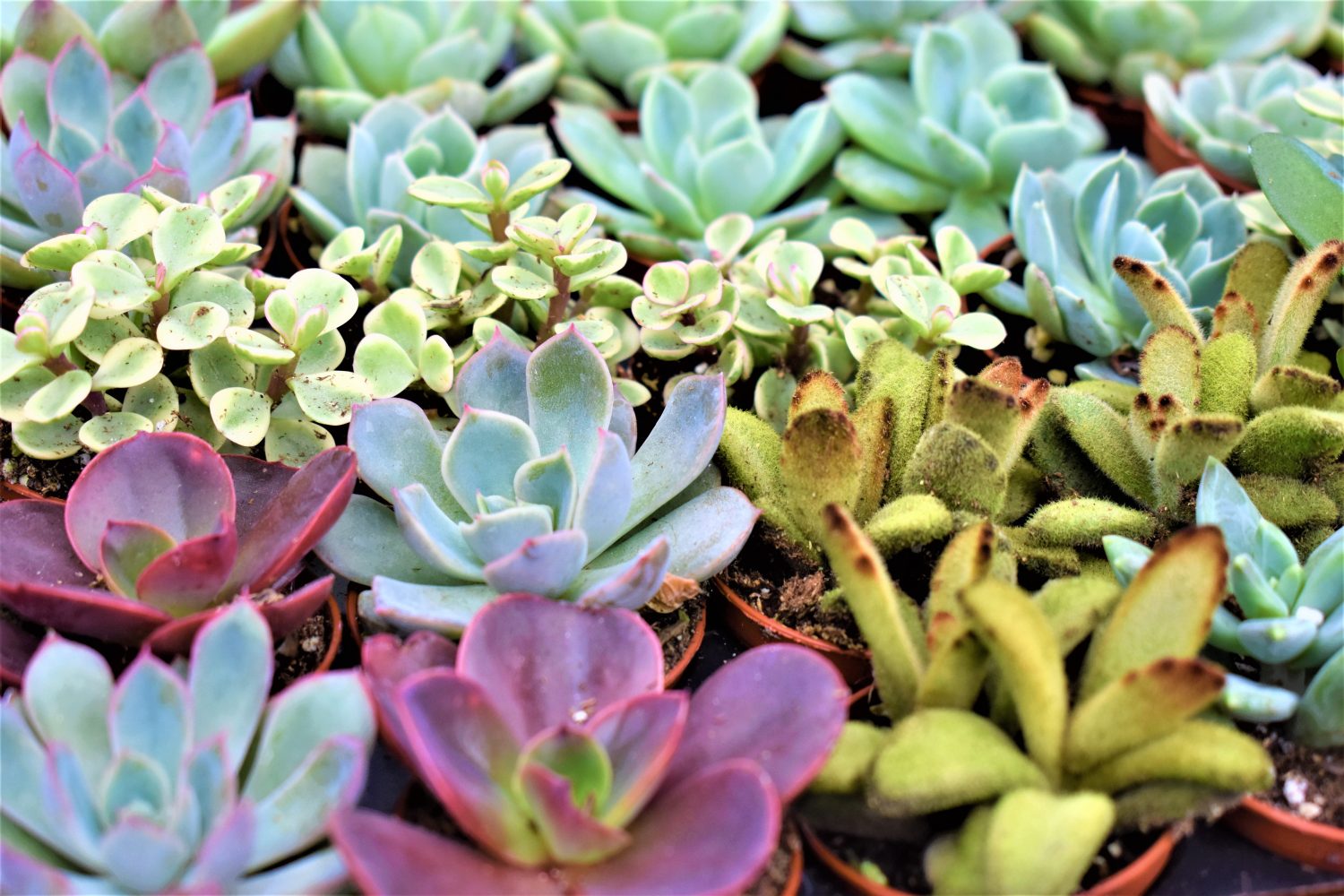
When it comes to plant classification, “Succulent” is a loose term with no single definition. It refers to any plant with fleshy parts. The leaves, stems, or roots store moisture to tolerate drought. Many collectors have given the plant a nickname of succs.
There are about 10,000 different types of succulent plants, about 2000 of which are in the cactus family.
The remaining succulents are from about 60 families of plants. These include commonly known groups such as the poinsettia or spurge family. Other groups include the periwinkle family and the milkweed family. There is also the aloe family and the sesame family. Additionally, the orchid family and even the grass family are part of these groups.
Succulents Are Prehistoric.
The first succs sprung up when the earth’s climate became just right around 5 to 10 million years ago. Researchers propose that a prolonged dry spell opened new habitats. Lower levels of atmospheric carbon dioxide also contributed. These changes helped in the rise of these plants and a broad vegetative makeover on Earth.
Cacti originated in South America before that landmass was connected to North America.
Today, Mexico is known for its wide variety of cacti that have evolved there.
South Africa is home to more types of succulents than anywhere else. In some regions, nearly all visible plant life is succulent, including the trees and shrubs.
Because they are full of water some succulents, like the popular lithops, mimic rocks. Others, like avonias, look like bird droppings in order to camoflauge themselves.
All Cacti are Succulents, but NOT all Succulents are Cacti
Can you drink from a cactus? No, cactus tissue is a lot like a cucumber without the seeds. Many contain poisonous, bitter alkaloid chemicals that make you vomit.
Yet, one of the most impressive features of a cactus is that this plant serves as a natural water reservoir.
The liquid stored in it is not clear like water but looks like a thick viscous substance.
This liquid is safe for human consumption. It can be obtained for drinking by scratching or making a hole in the columnar cactus. This fluid has saved several lives in the desert regions.
The size of the leaf tells a story of its origins.
Smaller leafed succs grow better in higher elevations, their native habitat. Some sedums grow in alpine areas and produce small flowers in the early spring.
Many succulents have interesting pollinating mechanisms. For example, the flowers of some stapeliads in the milkweed family attract pollinating flies. They do this by looking and smelling like the flesh and fur of dead animals.
Cactus flowers are big; and are found in a variety of colors like red, yellow, pink, etc. Some of the cactus flowers can bloom for many days, while others die within a day.
Many of these flowers bloom only during the nighttime and some of them require daylight. The nocturnal blooming species of this plant is primarily pollinated by bats and other nocturnal insects and animals.
The succulent plant’s lifespans vary and can be 300 years!
| Family or subfamily | Succulent # | Modified parts | Distribution |
|---|---|---|---|
| Agavoideae | 300 | Leaf | North and Central America |
| Cactaceae | 1600 | Stem (root, leaf) | The Americas |
| Crassulaceae | 1300 | Leaf (root) | Worldwide |
| Aizoaceae | 2000 | Leaf | Southern Africa, Australia |
| Apocynaceae | 500 | Stem | Africa, Arabia, India, Australia |
| Asphodelaceae | 500+ | Leaf | Africa, Madagascar, Australia |
| Didiereaceae | 11 | Stem | Madagascar |
| Euphorbiaceae | > 1000 | Stem, leaf, or root | Australia, Africa, Madagascar, Asia, the Americas, Europe |
| Portulacaceae | ~500 | Leaf and stem | The Americas, Australia, Africa |
Succulents Can Save Mankind!
• “Aloe vera,” aka Aloe barbadensis, has been used for its healing properties since 2200 BC. Rubbed on the skin, it promotes skin cell growth, especially helpful for burn patients.
• An African succulent called Hoodia in the milkweed family is known for its strong appetite suppressant properties.
Hoodia has long been used by native Africans on extended journeys and may eventually find its way into pharmaceuticals.
•Tequila comes from the distilled heart of the blue agave, Agave tequilana. Mescal comes from several different agaves gathered from the wild.
Approximately, 15 pounds of agave piñas or hearts are required to produce one liter of delicious tequila. Each plant is over seven years old before harvesting.
• Agave sisalana is native to Mexico. It is a source of sisal or hemp. It is grown as an agricultural crop in many tropical countries.
•Dioscorea elephantipes, elephant’s foot, make a precursor of cortisone. Th
The medicinal traits of Euphorbia are used to treat inflammation-related disorders. These traits are distributed all over the genus. There is a special concentration in subgenus Chamaesyce and Euphorbia.
One example of a plant that is used to protect people from witchcraft attacks is Haworthia fasciata.
What Makes Succulent NOT Suck?
Not Only Are They Candy… BUT…
They Can Brighten A Home in Any Climate.
They Can Help to Purify the Air.
They Improve the Humidity of Your Home.
They Can Add Fresh Oxygen to Your Environment.
They Can Improve Your Focus.
They Can Increase Pain Tolerance.
They Enhance Memory.
Click to read Why We Need Plants Around Us from a page on our website.
NASA and Succulents….
NASA has determined that the natural, ongoing plant-based production of oxygen can help improve the atmosphere aboard spacecraft. The removal of carbon dioxide also contributes to a safer atmosphere for long-term space travel.
In the Cactus-Mediated Carbon Dioxide Removal in Microgravity experiment, the goal is to measure two things. This experiment is also called Space Tango Payload Card Cactus. First, the oxygen (O2) output of a selected type of cactus plant. Second, the carbon dioxide (CO2) intake of that plant.
This could be beneficial to future human space exploration. It would require CO2 removal and O2 production to be replicated safely. This process must be maintained in a microgravity environment.
Like what you read? Appreciate the information. We are a non-profit 501c3! Thank us with a contribution by clicking DONATE!
Leave a Reply