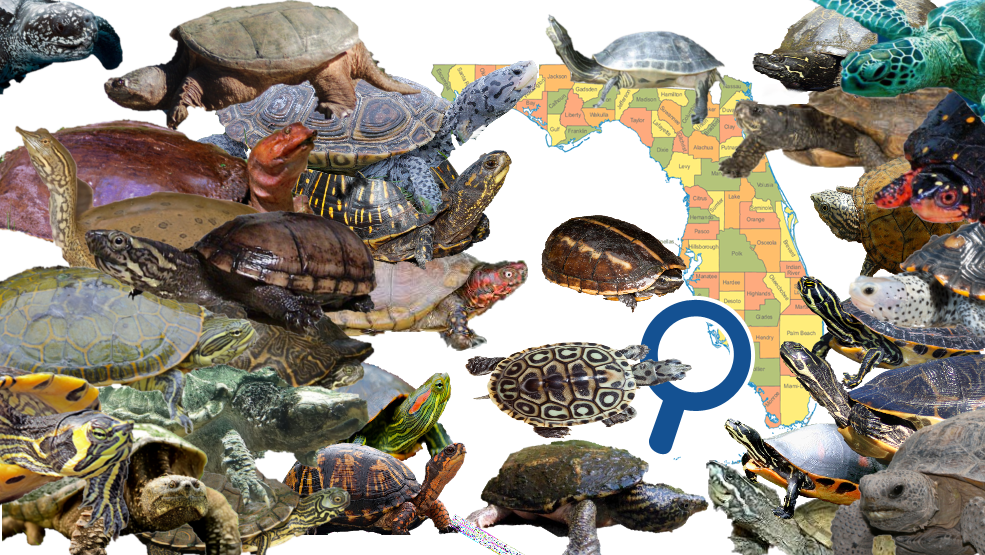
More than 30 species of turtle call Florida home. While the majority are primarily aquatic, several varieties live on the land, such as box turtles and gopher tortoises.
From time to time, we humans come in contact with turtles. Often they are crossing the roads. If you must intervene, simply help the turtle get to its destination by gently lifting near the rear. Placing the turtle in a safe location. Please read the rules and regulations at the bottom of this page. They give more on FWC guidelines on which ones you are permitted to help.
Turtles are very beneficial and are a biological indicator species. Biological indicators are species that help monitor the health of an environment. For example, frogs and salamanders can be used in this way.
All Tortoises Are Turtles….
In the classification of life all tortoises are turtles but not all turtles are tortoises.
All turtles play crucial roles in their ecosystems because turtles are omnivores and feed on animals and plants. Turtles also provide seed dispersal and manage vegetation. They control insects and snails. They contribute to nutrient cycling. They keep the water clean by scavenging dead animals. They also prey on weak or sick individuals.
Some turtle species consume algae that deplete oxygen from the water if grown without control.
Florida NATIVE Species List
- Chelonidae (sea turtles)
- Loggerhead sea turtle, Caretta caretta
- Green sea turtle, Chelonia mydas
- Hawksbill sea turtle, Eretmochelys imbricata
- Kemp’s ridley sea turtle, Lepidochelys kempii
- Trionychidae (softshells)
- Florida softshell turtle, Apalone ferox
- Smooth softshell turtle, Apalone mutica
- Spiny softshell turtle, Apalone spinifera
- Chelydridae (snapping turtles)
- Common snapping turtle, Chelydra serpentina
- Apalachicola alligator snapping turtle, Macrochelys apalachicolae
- Suwannee alligator snapping turtle, Macrochelys suwanniensis
- Alligator snapping turtle, Macrochelys temminckii
- Emydidae (freshwater turtles)
- Spotted turtle, Clemmys guttata
- Chicken turtle, Deirochelys reticularia
- Barbour’s map turtle, Graptemys barbouri
- Escambia map turtle, Graptemys ernsti
- Diamondback terrapin, Malaclemys terrapin
- River cooter, Pseudemys concinna
- Coastal Plain cooter, Pseudemys floridana
- Florida red-bellied cooter, Pseudemys nelsoni
- Common box turtle, Terrapene carolina
- Common slider, Trachemys scripta
- Kinosternidae (mud and musk turtles)
- Striped mud turtle, Kinosternon baurii
- Eastern mud turtle, Kinosternon subrubrum
- Loggerhead musk turtle, Sternotherus minor
- Common musk turtle, Sternotherus odoratus
- Testudinidae (tortoises)
- Gopher tortoise, Gopherus polyphemus
Sea Turtles
Loggerhead Sea Turtle (Caretta caretta), also called commonly the loggerhead, is a species of oceanic turtle distributed throughout the world.

This is a marine reptile, belonging to the family Cheloniidae.
Loggerhead Sea Turtles are classified as vulnerable by the International Union for the Conservation of Nature. They are listed under Appendix I of the Convention on International Trade in Endangered Species, making international trade illegal.
Green Sea Turtle (Chelonia mydas), also known as the green turtle, black (sea) turtle, or Pacific green turtle.
This is the only species in the genus Chelonia. Its range extends throughout tropical and subtropical seas around the world,

There are two distinct populations in the Atlantic and Pacific Oceans, but it is also found in the Indian Ocean.
The International Union for the Conservation of Nature (IUCN) has repeatedly listed green sea turtles in its Red List. They did so under differing criteria. In 1982, they officially classified it as an endangered species. 1986,1988, 1990, 1994, and the landmark 1996 edition of the IUCN Red List retained the listing.
Leatherback Sea Turtle (Dermochelys coriacea) is sometimes called the lute turtle. It is also known as the leathery turtle or simply the luth. It is the largest of all living turtles. It is the fourth-heaviest modern reptile behind three crocodilians.

This is the only living species in the genus Dermochelys and family ermochelyidae.
D. coriacea is listed on CITES Appendix I, which makes export/import of this species (including parts) illegal.
The species is listed in the IUCN Red List of Threatened Species as VU (Vulnerable). Additionally, it has the following infraspecific taxa assessments.
Recognize Sea Turtles:
…Yes, I see turtles!
Hawksbill turtles have dark flippers. They have a long, narrow beak. The rear part of their ornate shells has a jagged, spiked edge. The scutes (or shell plates) overlap at each trailing edge, much like roof shingles. There are often barnacles growing on their shells.
Green turtles have short beaks with two big scales between their eyes. The flippers are dark on young individuals, then lighten as the turtle grows. The shells of green turtles may have many different shades and patterns of sunbursts and speckles. However, they are almost always very smooth and clean in appearance. Unlike the hawksbill, they do not form spikes in the rear. Typically, few barnacles are found on green turtles.
Loggerhead turtles, as the name implies, have disproportionately large heads for the size of their bodies. They are usually copper in color, with light brown flippers, and attain impressive sizes (350+ lbs.). Their shells lack the ornate patterns of greens and hawksbills and are usually host to large barnacles.
Leatherback turtles are the largest of the world’s sea turtles. They are usually more than six feet long. They are basically black, but have varying numbers of white speckles covering their bodies. They have 7 ridges running from front to back down the shell, which is covered with delicate leathery skin.
Kemp’s Ridley turtles are rarely seen in our waters but do make stops here during their annual migrations. Ridleys are grey in color on both the shell and flippers, and their beaks form a pronounced ‘overbite’. The shell is nearly round, rather than heart-shaped as with the other sea turtle species.
Softshell Turtles
Florida Softshell Turtle (Apalone ferox) is a species of softshell turtle found primarily in the state of Florida. It also ranges to the southern sections of South Carolina, Georgia, Alabama, Tennessee, and Texas.
It is the only species of softshell turtle whose range spans the entire Florida peninsula.
The Florida Softshell Turtle is protected in the state of Florida. You can not touch them from May through July during the nesting season.

The Florida Softshell Turtle is common throughout Florida and other parts of its range. Yet, wild populations are exposed to various threats at the hands of humans. Some of these threats include commercial harvesting for meat, harvesting for the pet trade, and roadway mortalities

Gulf Coast Spiny Softshell Turtle (Apalone spinifera aspera), a subspecies in the Trionychidae family of softshell turtles.
Identify Softshell Turtles:
They ain’t so soft!
The Florida softshell turtle is a large, flat turtle with skin covering its shell (resembling a pancake). It is the bulkiest of the softshell turtles.
The carapace of the Florida softshell is covered with longitudinal rows of tubercles.
Eastern spiny softshell: Thickly-bordered, large black ocelli in the middle of the carapace with a pale rim with black inner border.
Pallid spiny softshell has mall white spots and is ringed black in adult males. There are no obvious spots on the anterior and no distinct border.
Guadalupe spiny softshell has large white spots and is ringed black in adult males. Spots are found on the anterior and posterior and have no distinct borders.
Texas spiny softshell has white spots (not ringed with black). The spots present only on the posterior third of the carapace. There is a pale rim, widest posteriorly.
Gulf Coast spiny softshell has back spots and/or ocelli; 2-4 dark lines on the posterior carapace. The Ocelli is the largest in the middle of the carapace. The rim is a pale rim with a black inner border
Snapping Turtles
Common Snapping Turtle (Chelydra serpentina) natural range extends from southeastern Canada. It stretches southwest to the edge of the Rocky Mountains and as far east as Nova Scotia and Florida. This is a large freshwater turtle of the family Chelydridae.

The Common Snapping Turtle is presently classified as Least Concern by the IUCN. Nonetheless, its population has declined due to pressure from collection for the pet trade. Habitat degradation has also contributed to its decline. As a result, Canada and several U.S. states have enacted or are proposing stricter conservation measures.
In Canada, it was listed as ‘Special Concern’ in the Species at Risk Act in 2011. It is a target species for various projects. These projects include surveys and identification of major habitats. They also involve the investigation and mitigation of threats. Education of the public, including landowners, is another focus. Involved bodies include governmental departments, universities, museums, and citizen science projects.
Florida Snapping Turtle (Chelydra s. osceola) is confined to the Florida peninsula.

Alligator Snapping Turtle(Macrochelys temminckii) is a species of turtle in the family Chelydridae. The species is native to freshwater habitats much of the United States.

Some states have imposed bans on collecting alligator snapping turtles from the wild. This is due to the collection for the exotic pet trade. They are also overharvested for their meat, and their habitat is destroyed.
The IUCN lists it as a threatened species. As of June 14, 2006, it received some international protection. It was listed as a CITES III species. This listing will put limits on exportation from the United States. It will also restrict all international trade in this species.
The alligator snapping turtle is now endangered in several states. These include Kentucky, Indiana, Illinois, and Missouri. In these states, they are protected by state law. They are designated as “in need of conservation” in Kansas.
In October 2013, one was found in the Prineville Reservoir in Oregon. The Oregon Department of Fish and Wildlife captured and euthanized it. They consider alligator snapping turtles to be an invasive species. This one was the first found in that state.
Identify Snapping Turtles:
If it hurts when it bites, it is a snapper!
Do not try this at home!
The shell of the common snapper seems to be quite smooth. This is especially true in larger individuals. In contrast, the alligator snapper’s shell has easily distinguishable individual scutes. It has a distinctly bumpy feel.
Although the alligator snapper’s shell also becomes smoother with age, the ‘rougher’ feel never really goes away.
You can also see the difference in the shape of their heads as you look at them from above. The alligator snapper has a triangular, pointed head, while the common snapper’s head is more oval.
The alligator snapping turtle has a unique feature. It is the fleshy lure located at the bottom of its mouth. This lure is easily spotted when the turtle opens its jaws.
The alligator snapper is the only turtle in the world with such a ‘device’. With its jaws open, the turtle fools fish into believing its lure is a live worm. Once a fish enters this trap to take a bite, it becomes a meal itself. The common snapper does not have such a lure.
Another unique feature found on the alligator snapping turtle is a fleshy eyelash-like growth around its eyes. Again, the common snapping turtle lacks these features.
Mud and Musk Turtles:
Striped Mud Turtle (Kinosternon baurii ) is a species of turtle in the family Kinosternidae.
The species is endemic to the southeastern United States. It is common and not found on any protected animal list.

Eastern Mud Turtle (Kinosternon subrubrum) or common mud turtle is a common species of turtle endemic to the United States.

In Indiana, the Eastern mud turtle is listed as an endangered species.
Eastern mud turtles are found in several US states. These include Alabama, Arkansas, Delaware, Florida, Georgia, Illinois, Indiana, Kentucky, Louisiana, and Maryland. They are also found in Mississippi, Missouri, New Jersey, New York, North Carolina, Oklahoma, Pennsylvania, and South Carolina. Additionally, they inhabit Tennessee, Texas, and Virginia.
Loggerhead Musk Turtle (Sternotherus minor ) is a species of turtle commonly found in several states. These include Alabama, northern Florida, and Georgia. They are also found in extreme southeastern Kentucky, extreme eastern Louisiana, and Mississippi. Additionally, they inhabit extreme western North Carolina, eastern Tennessee, and extreme southwestern Virginia.

Loggerhead musk turtles intended for the pet trade were removed from Florida springs in the 1980s as well, heavily damaging the population.
Stripeneck Musk Turtle (Sternotherus minor peltifer) range stretches from southwest Virginia. It also extends through eastern Tennessee to the Gulf and the Pearl River in Mississippi.
Populations of stripe-necked musk turtle in Virginia and Alabama have seen a decline since the 1980s, according to anecdotal observations.

This species appears to remain abundant across much of its range. However, loggerhead musk turtles are vulnerable to pollution and siltation of their habitat. This affects prey abundance.
Eastern Musk Turtle (Sternotherus odoratus) is a species of small turtle. It is native to southeastern Canada and much of the Eastern United States.

It is commonly known as the common musk turtle, eastern musk turtle, or stinkpot.
Though the common musk turtle holds no federal conservation status in the US.
It is quite common throughout most of its range. Nevertheless, it has decreased significantly in some areas. It seems to be more sensitive than some native species to human degradation of wetlands.
It is listed as a threatened species in the state of Iowa. It is recognized as a species at risk in Canada. The federal Species at Risk Act (SARA) protects it.
Added, it is protected under Ontario’s Endangered Species Act. In this part of its range, only wetlands with minimal human impact have robust populations. Road mortality of breeding females is one of the problems associated with human development.
Identify Mud and Musk:
You can easily do this with smell!
That is why some are called stink pots!
Both mud and musk turtles grow to be approximately 4-6 inches long. They are a smaller turtle. Their carapace (shell) can be smooth, olive to dark brown. Both species have hinged plastrons.
Mud turtles have a much better-developed plastron than the musk turtle, for better protection. Stinkpots seem to have more pointed faces than the Mississippi mud turtles.
All of these small to medium-sized turtles have barbels (BAR-buhls). These are small bits of flesh. They dangle from the chin.
The three turtles in the Staurotypinae subfamily (S. salvinii, S. triporcatus and C. angustatus) are distinguished by the presence of three keels running the length of the carapace, their size (in Staurotypus) and their aggressive disposition. C. angustatus also has two distinct cusps on its upper jaws to identify it. S. salvinii can be distinguished from S. triporcatus by its smaller size and also by its wider and more flattened carapace.
Four species of Sternotherus are recognized. Sternotherus carinatus, the Razor-backed musk turtle, deserves its name. This turtle has a very sharply sloping carapace – when viewed from the front, the turtle appears to be triangular. The plastron only has ten scutes, unlike the rest of the species of Sternotherus and Kinosternon.
The Flattened musk turtle, S. depressus, also is aptly named. Its carapace is very flattened and wide. It has been considered a subspecies of S. minor in the past.
The Loggerhead musk turtle, S. m. minor, has a carapacial shape that is intermediate between S. depressus and S. carinatus. Like the rest of the genus, S. minor species have a single weak hinge between the abdominal and pectoral scutes of the plastron. S. minor peltifer differs from the Loggerhead musk by the presence of strong stripes on its neck.
The most commonly known musk turtle, S. odoratus, the Common musk turtle, or Stinkpot as it is occasionally called, has a small plastron. It features two distinctive stripes on each side of the face. These stripes run back from the snout and go to either side of the eyes.
Five species of Kinosternon are found in the United States. Possibly the most easily recognized is K. baurii. This chelonian is small, even for mud turtles, and has three light stripes running the length of the carapace. As with all mud turtles, it has two strong plastral hinges.
Overlapping geographically with the Striped mud turtle is the Common mud turtle, K. subrubrum. This turtle is also small, but lacks the carapacial striping. It is rather nondescript. Some specimens have occasional markings. These are usually in the form of yellow mottling or faint stripes on the head, especially in K. s. hippocrepis. This subspecies is sometimes confused with K. baurii, which it greatly resembles except for the carapacial striping.
Further west, one encounters the Yellow mud turtle, K. flavescens. The carapace is a drab olive or brown, while the skin is yellow, ranging to grey. Two other species just enter the United States: K. hirtipes and K. sonoriense. The Sonoran mud turtle is a medium sized mud turtle. It is somewhat elongated with an olive-brown carapace. Its grey skin has darker mottling. Only one subspecies of the Mexican mud turtle, K. hirtipes murrayi, enters the United States, down in Texas. This species has three carapacial keels, while the skin is dark with a fine reticulated pattern on the head.
To the untrained eye, many of the mud and musk turtle species are very similar. Wild populations contain individuals that complicate this similarity. Some are integrated or hybrids between different populations and species.
Pond Turtles, Sliders, and Cooters
Spotted Turtle (Clemmys guttata), the only species of the genus Clemmys. It can be found from southern Canada (Ontario) to the eastern Great Lakes and east of the Appalachian Mountains.

In Canada, the spotted turtle is federally endangered. In the United States, the spotted turtle is currently under review by the Fish and Wildlife Service. They are considering its protection under the Endangered Species Act.
It is listed by the IUCN as endangered and has “listed” status in many of the states where it occurs. For example, in Indiana, the spotted turtle is listed as an endangered species. In the Northeast, it has protective status in five of the six New England states. It is listed as a species of special concern in New York.
Habitat destruction and alteration are causing population declines. Collection for the pet trade also affects populations. Other human impacts, such as vehicle mortality (cars and mowers), contribute to the decline.
Florida Chicken Turtle (Deirochelys reticularia) is an uncommon freshwater turtle found in the southeast of the United States.
The Chicken Turtle is in the monotypic genus Deirochelys.

Eastern Chicken Turtle (Deirochelys reticularia reticularia) is supposed to occur throughout the Coastal Plain. It is also found in a part of the Ridge and Valley in Virginia. But it can be found in Florida.

The name “chicken” turtle refers to the taste of their meat, which used to be popular in the southern market.
Chicken turtle populations are now considered stable throughout their range, although they do face potential threats. The eastern chicken turtle species is listed as state threatened in Virginia.
Barbour’s Map Turtle (Graptemys barbouri ) is a species of turtle in the family Emydidae. The species is endemic to the southeastern United States.
G. barbouri is found in rivers located in southeastern Alabama, the western panhandle of Florida, and southwestern Georgia.

Owning Barbour’s map turtles is illegal in Georgia, Michigan, and Alabama. The limit is two turtles per person in Florida.
River Cooter (Pseudemys concinna) is a species of turtle in the family Emydidae. It is a freshwater turtle native to the central and eastern United States. Its range extends from Virginia south to mid-Georgia, west to eastern Texas, Oklahoma, and north to southern Indiana.

In Indiana, the river cooter is listed as an endangered species.
Florida redbellies are commonly exported for consumption and the pet trade, with about 50% wild-caught individuals and 50% captive bred.


Peninsula Cooter (Pseudemys peninsularis) is widespread in peninsular Florida.
Peninsula Cooters are sometimes considered a subspecies of the coastal plain cooter (P. floridana) when that turtle is not itself considered a subspecies of the river cooter (P. concinna).
Suwannee Cooter (Pseudemys concinna suwanniensis) is endemic to Florida, including in the Suwannee River.
P. c. suwanniensis was hunted for its meat, but is now protected.

Red-eared Slider (Trachemys scripta elegans), also known as the red-eared terrapin in the family Emydidae.

It is native to the southern United States and northern Mexico, but has become established in other places because of pet releases.
The red-eared slider outcompetes native species. It is included in the list of the world’s 100 most invasive species published by the IUCN.
Yellowbelly Slider (Trachemys scripta scripta) is a land and water turtle belonging to the family Emydidae.

The pond slider is the most common turtle species.
This subspecies of pond slider is native to the southeastern United States, specifically from Florida to southeastern Virginia.
Identify Pond Sliders and Cooters:
If it is invasive, remove it and call FWC.
It can be hard to get these right!
Often it is extremely difficult to distinguish the cooter and the slider, even at close range, unless binoculars are used. The best identifying marks are on the side of the head. The cooter has narrow, yellow, horizontal lines and the slider has one wide vertical yellow band directly behind the eye.
Older turtles are often covered with a mat of mud and algae. This covering does not reveal the intricate and beautiful patterns on the carapace, or top of the shell. But young cooters show an astonishing paisley pattern, and on sliders, a series of vertical oval markings is visible. In ancient China, people said these markings reveal the future. This would happen if one encountered a turtle in the wild.
There are four types of the painted turtle. They are classified according to their range. These types include the eastern painted, midland painted, western painted, and southern painted turtle.
These turtles will have black skin and a smooth, sleek, dark-colored carapace. It is separated by deep lines. These lines make up the different shell sections called scutes.
Around the edges of its shell and underneath will be streaks of orange and red lines, which are brightly visible. The bottom of its shell will usually be a dull yellow or brown color.
To tell the difference between a red-eared slider and a painted turtle, examine the red coloring on the turtle. This is an easy way. Pay attention to how much red there is and where it is located.
The characteristics that most obviously distinguish the Red-ear and the Yellowbelly Slider are varied. They include yellow marginal scutes and a yellow plastron. This plastron is covered in dark, blotchy markings. There is also a red earmark located just behind the eye. However, this earmark is not always visible in older specimens. Their upper shells are usually a little steeper in comparison to those of some painted turtles.
These turtles do crossbreed and can be found with any mixture of the above patterns and colors. The hybrids are said to have voracious appetites which make them bad for the environment. Unlike the natural native pond sliders.
Terrapin
Diamondback Terrapin (Malaclemys terrapin) belongs to the monotypic genus, Malaclemys.
Common Diamondback Terrapin (Malaclemys terrapin) has one of the largest ranges of all turtles in North America. Its range stretches as far south as the Florida Keys. It extends as far north as Cape Cod.


Ornate Diamondback Terrapin (Malaclemys terrapin macrospilota) can be commonly found from the northern Keys to the panhandle of Florida.
Mangrove Diamondback Terrapin (Malaclemys terrapin rhizophorarum)is restricted to the Florida Keys.

TheTerrapin species is classified as Near Threatened by the IUCN due to decreasing population numbers in much of its range. There is limited protection for terrapins on a state-by-state level throughout their range.
Some are listed as Endangered, for example, in Rhode Island, and Threatened in Massachusetts. Yet, there is no national protection except through the Lacey Act, and little international protection.
Find Terrapin Turtles:
No two individual diamondback terrapins are exactly alike in coloration and pattern.
Their skin color is a pale to dark gray or black, flecked with dark spots, blotches, or stripes. The hingeless plastron (bottom shell) is yellow to green or black and is marked with dark blotches.
Box Turtles
Eastern Box Turtle (Terrapene carolina carolina) is a subspecies within a group of hinge-shelled turtles, normally called box turtles. T. c. carolina is native to the eastern part of the United States.
In 2011, the IUCN noted “a widespread persistent and ongoing gradual decline of Terrapene carolina.” This decline probably exceeds 32% over three generations. As a result, they downgraded its conservation status from Near Threatened to Vulnerable.

Florida Box Turtle (Terrapene carolina bauri ) is a subspecies of turtle belonging to the family Emydidae and is one of four subspecies of the common box turtle (T. carolina).

Like other subspecies of T. carolina, the Florida box turtles are listed on the IUCN red list as a vulnerable species.
Wild populations face multiple threats. Predation of eggs and juveniles by raccoons, possums, foxes, and birds is a significant risk. Habitat loss and modification also threaten them. Extra dangers include car strikes, pesticides, pollution, and collection for the pet trade and turtle racing.
Seasonal fire regimes in Florida are a major cause of death for box turtles. Burns have the potential to kill off nearly half of a population. Yet, the mortality rate of turtles is lower during dry-season burns as opposed to wet-season burns. This is due to its inactivity and its tendency to spend more time underground during the dry season.
Gulf Coast Box Turtle (Terrapene carolina major) is the largest subspecies of the North American box turtle (Terrapene carolina).
The Gulf Coast box turtle inhabits areas along the Gulf of Mexico. It ranges from the state of Louisiana to the state of Florida.

Three-toed Box Turtle (Terrapene carolina triunguis) is a subspecies. It belongs to the genus of hinge-shelled turtles commonly referred to as box turtles. This subspecies is native to the south-central part of the United States. It is the official reptile of the state of Missouri.

Three-toed box turtles are named for the number of toes on their back feet. However, some think that there are some 4-toed examples too.
Still, some speculate that the 4-toed individuals are actually Eastern box turtle × three-toed box turtle hybrids.
The three-toed box turtle can be found from eastern Texas to the northern edge of the Florida Panhandle. Its range extends from the west to the east. Its northernmost habitat is in Missouri and Kansas, while the southernmost is in Louisiana.
Three-toed interbreed with other subspecies of eastern box turtles, which overlap the borders of this area. This happens in the eastern Mississippi Valley. In this region, this species is difficult to distinguish from the common box turtle.
Recognize Florida Box Turtles:
The box turtle that is!
Let’s let the secret out of the box!
The Florida box turtle typically has yellow radiating bands on a very domed shell (carapace). It also features yellow stripes on each side of its head.
The males of this subspecies show a very noticeable concavity on the bottom of their shells, also known as plastron. In contrast, the plastron of male three-toed box turtles tends to be nearly flat.
Three-toed box turtle often has plain olive-brown shells but may show yellow spots on the carapace and head. This subspecies gets its name from the number of toes on its hind feet. However, be aware that Florida box turtles sometimes have three hind toes as well.
The Gulf Coast box turtle can have white blotches on the head. It is the largest of all box turtles. The back of its shell distinctively flares upward in a gutter-like fashion. This is in contrast to the downward-angling shell of the eastern box turtle. Gulf Coast box turtles are darker and less boldly marked than the Florida or eastern subspecies. Some individuals have white blotches on their heads.
Tortoise
You can not make a mistake because we only have one species!
Gopher Tortoise (Gopherus polyphemus) is a species of the Gopherus genus native to the southeastern United States. The gopher tortoise is a keystone species. It digs burrows that provide shelter. At least 360 other animal species use these burrows.

This species of tortoise is the state reptile of Georgia and the state tortoise of Florida.
The gopher tortoise is a representative of the genus Gopherus, which contains the only tortoises native to North America.
Since July 7, 1987, the U.S. Fish and Wildlife Service has listed Gopherus polyphemus as “Threatened”. This status applies wherever the tortoises are found west of the Mobile and Tombigbee Rivers in Alabama, Mississippi, and Louisiana. Its status is listed as “Under Review” in Florida and other locations.
On November 9, 2009, the U.S. Fish and Wildlife Service proposed a rulemaking. They aimed to include the eastern population of Gopherus polyphemus in the List of Threatened Wildlife.
G. polyphemus appears on the IUCN Red List as a “Vulnerable” species. Nonetheless, it has not been assessed for the purposes of this list since 1996. In July 2011, the United States Fish & Wildlife Service (USFWS) decided that the eastern population of the tortoise should be listed as Threatened. This listing falls under the Endangered Species Act. However, they cannot move forward at this time due to higher priority actions and insufficient funds for proposed rule development.
Recognize Gopher Tortoises:
It can be easy to confuse the Sulcata with the Gopher. The Gopher tortoise shells are smoother than the Sulcata’s shell and it will not have spurs on its hind legs.
Rules and Regulations
All for one and one for all! We can not break these rules either!
A 1975 U.S. Food and Drug Administration (FDA) regulation bans the sale of turtle eggs for general commercial and public use. It also bans the sale of turtles with a carapace length of less than 4 inches (100 mm).
The Commission became concerned with the increasing popularity of turtles. They saw the potential for over-harvest. As a result, the Commission passed stronger rules to protect turtle species. They also developed a long-term turtle conservation strategy. Selling turtles taken from the wild is prohibited.
FWC rules prohibit taking or possessing turtles from the wild that are listed on Florida’s imperiled species list. These turtles are listed as imperiled:
- Alligator snapping turtles (Macrochelys temminckii)
- Barbour’s map turtles (Graptemys barbouri)
- Suwannee cooters (Pseudemys suwanniensis)
Also prohibited is taking species that look similar to the imperiled species, which include common snapping turtles and cooters.
- Cooters (Pseudemys sp.)
- Escambia Map Turtle (Graptemys ernsti)
- Snapping turtles (Chelydra serpentina)
For all other freshwater turtles, take is limited to one turtle per person per day. This applies from midnight to midnight and must be from the wild for noncommercial use. The transport of more than one turtle per day is prohibited. Exceptions are made if the transporter has a license for the sale or exhibition of wildlife. Other valid exceptions include having an aquaculture certification from the Department of Agriculture and Consumer Services. They also include documentation that their turtles were legally obtained (proof of purchase).
Freshwater turtles can only be taken by hand, dip net, minnow seine, or baited hook. Most freshwater turtles can be taken year-round. Taking turtles with bucket traps, snares, or shooting with firearms is prohibited. Softshell turtles not be taken from the wild from May 1 to July 31. In addition, collecting freshwater turtle eggs is prohibited.
Possession limits for the following turtle species and their eggs are as follows:
- Loggerhead musk turtles – two
- Box turtles – two
- Escambia map turtles – two
- Diamondback terrapins – two
No one may sell turtles taken from the wild in Florida. In addition, no one may buy, sell, or possess for sale alligator snapping turtles. Barbour’s map turtles and Suwannee cooters or parts thereof are also included.
Captive Wildlife no longer issues that Class III permit for LISTED turtle species. The Division of Habitat and Species Conservation now handles permitting. A Scientific Collecting Live Possession Permit is required. For more information, you can call 850-921-5990 or email WildlifePermits@MyFWC.com.
Buying, selling, taking, or possessing gopher tortoises, or parts thereof, is prohibited except by permit from the FWC executive director.
Additional regulations apply for sea turtles.
For additional information, see the Wildlife regulation 68A-25.002(9) of the Florida Administrative Code at https://www.flrules.org/Default.asp.
Non-native species that are released into the wild may compete with native species for habitat or food. They may prey on native wildlife. Non-native species can transmit diseases. In the case of the red-eared slider, they can interbreed with Florida’s native wildlife. FWC Rule 68-5.001, F.A.C., prohibits the release of any non-native animal in Florida.
Red-eared sliders are a common non-native turtle that has been popular in the pet trade. Red-eared sliders are listed as a conditional species in Florida. Anyone who possessed a pet red-eared slider before July 1, 2007, can legally keep their turtle. No permit is required. Yet, Floridians are not allowed to acquire red-eared sliders as personal pets after that date.
Anyone importing or possessing red-eared sliders for research, exhibition, or out-of-state sale is required to have a Conditional/Prohibited/Nonnative Species Permit. Certified aquaculturists with restricted species authorization from the Department of Agriculture and Consumer Services may possess and cultivate red-eared sliders. They can do so for out of state sale. They also sell to licensed Florida researchers, exhibitors, or dealers. Additionally, they can sell to other certified aquaculturists. Authorized aquaculturists who import red-eared sliders also must obtain a special permit.
Not sure what turtles you have? Click this interesting link to a database that can help you.
Leave a Reply